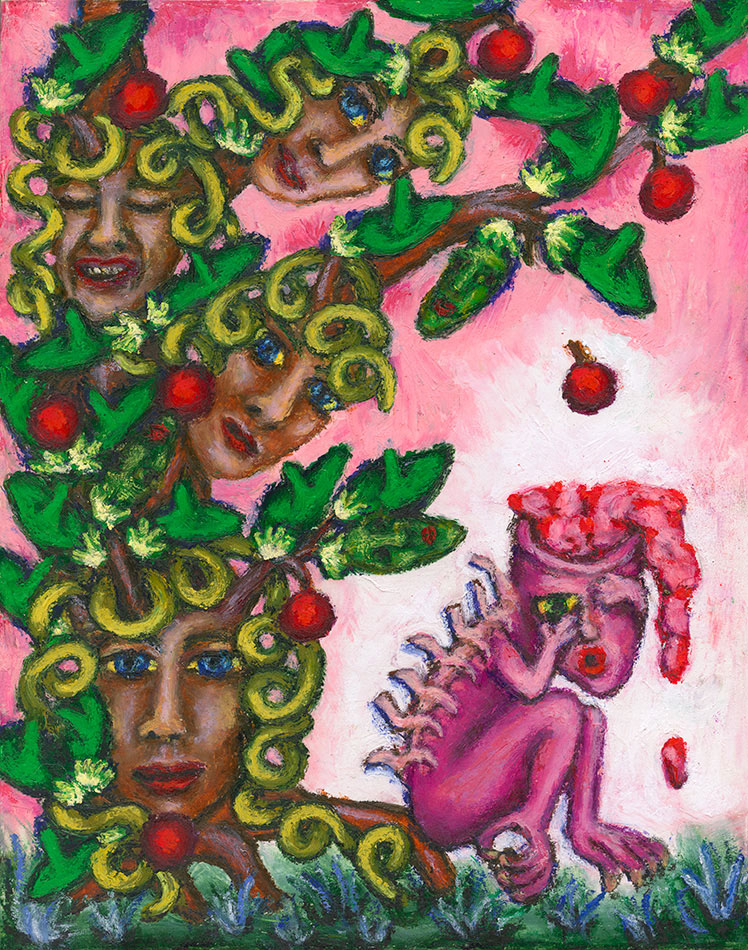
The title of this oil pastel drawing is "End of Life". When I was
designing it I didn't know what it was about, story wise. And I didn't
know what I was doing, nor what I was drawing, nor why why I was drawing
it. For a while there, I was really disturbed by what I was making.
The violence and darkness of the subject matter didn't bother me. I was
disturbed by internal variations in my normal sensation of creative
flow. In this drawing, somehow, my creative process was less
satisfactory.
However, its final phase, the story is
very straight forward and clear. The drawing is a variation on the
Greek myth of the three fates. The three fates were women who dealt
with string and the timing of one's life. One Fate to spin the string,
one Fate to measure the string, and one Fate to cut the string. So a
person's lifeline was created, you lived it out, and when a Fate cut the
string, you died. The black string in "End of Life" is perhaps less
about measurement and more about the assent from earth into the
afterlife. A journey is taking place. A transference. Movement from
the Earthly plane (why, there's green grass on the ground) to a more
celestial plane (the cart is flying through the blue sky). Note the
baby saint, or Jesus, in the womb of the winged Billy Goat. Is it a
symbol of rebirth? Is it a symbol of the destination of Heaven? Is it a
symbol of a plane of existence that I'm at loss to depict in a
drawing? I don't know, but somehow, I get a good feeling of hope from
my pregnant, cart hauling, aimed upward, winged Billy Goat. He isn't
the goat that is associated with the Devil, no way. Maybe its my own
personal spin on drawing an angel. An animal angel.
Where
there is flesh of the Godly Fates I used a lot of pink tones. Where
there is flesh of those that have died, I have used tones of green and
blue and brown.
I asked my husband, "Why are their
holes in the women's breasts?" and without hesitation he replied
"Because they lack the milk of human kindness."
But my
husband does not understand why all the dead people's faces have unhappy
looks on them. "Sometimes you say you want to die" he said to me. "If
you want to die, shouldn't the faces in death be happy? Because you
got what you want?" He continued on this line of thought. "I think
because the faces look unhappy, you really don't want to die, even when
you say so."
I got a notion that repeated itself to me
while planing and executing this drawing. I kept thinking that the
drawing was different from preceding work. And that the difference was
because I was showing early stages of Alzheimer's.
Now,
reality check. Do I have any sort of problems with my memory? No,
absolutely not. Still, I kept telling my husband, like a broken needle
on a record, "It feels like I have Alzheimer's when I draw." Do I know
anyone with Alzheimer's? No. But what I was trying to express, I
think, was that my thoughts felt blocked and slowed down. Schizophrenia
is a type of dementia, but I wanted to say that while making this art I
felt like I had dementia on top of dementia. Creative flow felt
altered, and not in a good way. It was my husband who pointed out to me
that during the Christmas season I had gone up, a tiny bit, on my
antipsychotic medication. Just one extra 20mg pill a night. The holiday time is a former time of
hospitalization. Its hard to remember, but I think I've had two
hospitalizations right before Christmas. So its a kinda a danger zone.
And since I was doing so well on the higher dose of medication I just
kept on taking the increased dose. More medication all throughout January. During the
planing and execution of this drawing. "Your probably really sensitive
to how the medication alters your creativity." My husband said to me.
"It must be that you don't like the way the medication affects your
creativity."
I have seen art transformed by
Alzheimer's. I think there was an unconscious reason I picked this
disease to describe how I felt.
A
couple of years ago I read a very good and detailed biography of the
abstract expressionist painter Willem De Kooning. When De Kooning was
at his best his work has intense energy and vitality. At the end of his
life De Kooning had Alzheimer's so bad he stopped speaking. I suppose
that's part of the normal course of Alzheimer's. At this point in his
life, when a paintbrush was put in his hand (oh, they were trying to get
him
to paint right up to the very end, he was so bankable) - all he would
paint on canvas was a circle. The story of his art was all there for me
to see in pictures in the book - early art training, decades of
artistic searching, the mastery and breakthrough, and eventual pictorial
dementia. I HAVE SEEN AN ALZHEIMER'S PIECE OF ARTWORK. WHEN I SAID MY
WORK LOOKED LIKE I HAD ALZHEIMER'S, I WAS SENSITIVE TO A SUBTLE
ALTERATION THAT MIMICKED EXISTING ALZHEIMER'S ARTWORK. I BELIEVE THIS
WAS BECAUSE OF A SMALL INCREASE IN ANTI-PSYCHOTIC MEDICATION.
When
De Kooning was good, he was very good. I especially liked his series
of Women, who were ugly sexual goddesses (sometimes with teeth!) that
dominated and made a strong subvocal statement to the viewer like "I
exist! I am solid! I am all woman! If you have sex with me I'll eat
you whole and spit out your ribcage!". The museum that I worked at in my youth had two de Koonings.
One was a delicate, somber, semi-realistic man relegated to the wall of a
staircase (not an esteemed position). The other painting was done
after fame had arrived, in signature abstract expressionist style.
This painiting was far more advanced, in power and scope, and was one of the lynchpins of the 20th Century art wing of the
museum. So, in a way, I've had the several year experience of live
contact with a massive, impressive de Kooning in addition to any of the
illustrations of his work that I've seen in books.
When
Willem De Kooning started his abstract expressionist style of painting
he pretty much became a success overnight. He had been known in the
artworld, lots of artist buddies, but not yet much noticed or talked
about by the art critics.
The trajectory of his talent proves to me that for some artists, they
must spend decades of searching before they find the style that exudes
power and creative grace. Van Gogh is another other example of an
artist who trained and searched before he became a master. Most people
agree that Van Gogh was a creative genius. Yet I own a two volume
complete set of reprints of his work, and for the first ten years
he was painting he was nothing more than an average painter (sometimes a
horrible painter!). Early Van Gogh had some definite flops. A Van Gogh
flop? You bet. For some artists, it takes years of practice and
dedication to get to the point where they exhibit the unearthly powers
of a creative genius. At the end of his life Van Gogh made a
masterpiece every day. You can be born with talent, maybe even genius,
but not many are genius prodigies, obvious and known at a young age.
Often there is a learning curve before the artistic miraculous happens.
In America the myth is that fame and fortune happens virtually
overnight (on American Idol?) and we forget that for some creative
stars there is muckcrawling and unrewarded practice for a long time.
Slogging away in darkness before the light shines. And when that light
shines, the artist truly becomes themselves. Unique and like no other.
That's when the art world notices the talent; when the artist breaks
with history and finds a signature style.
De
Kooning had a wife named Elaine who the biographer that wrote my book
didn't like very much. If you encounter her on Wikipedia, they seem to
be very nice to her. They name her among the greats of the abstract
expressionist movement. I think this is a weird lie - I've never seen
any work by her. I prefer to believe the author of my book. He never
pays attention to her art.
The DeKooning marriage wasn't much of a success. They both went on
to have affairs and stop living with one another. Yet they never
divorced. Elaine liked being married to a famous artist and she
especially liked big money. She was a mouth piece in the art world and
high society promoting her husband's work. When he started showing
signs of dementia, she covered it up as best she could. She got him
assistants sworn to secrecy. She moved him permanently out of New York
City to an isolated studio Willem had designed and built the country.
Elaine did not want the high prices his works commanded to deflate.
Afterall she was his wife and entitled to a large share of his income.
Elaine promoted the visual change in Willem's art as a next step in the
evolution of a master painter. It was true that up till then
DeKooning's
trajectory had always been one of evolution. At a point in
the 1980's the look of De Kooning's work definitely changed. The
abstraction in the paintings became very fluid. Looking a bit like it
had been smoothly poured in patches. Much different from earlier paint
that was broken,
gestural, interwoven, fast and furious. In late De Koonings forms of
color floated serenely. The
colors were all separated from one another. There was new peace and
order in the paintings. The dementia phase work was wholly abstract,
with no subtle reference what-so-ever to any object in reality. In my
museum's De Kooning there was a pair of lips. A lot of abstraction but a
definite nod as well to a red pair of feminine lips. The
late De Kooning canvasses were still interesting - that's probably why
the value held. De
Kooning's illness was relegated to rumor - but a definite departure in
style had occurred.
I swear that half way through this
drawing, when all the white of the paper had been eradicated by a first
layer of oil pastel , I felt such a violent rejection of my creation
that I wanted to destroy the artwork. What stopped me was all the time and effort that had already gone into the piece. I did
reason with myself. Feeling violent disgust toward my own creation is
something I've wrestled with before. Artwork has been destroyed, much
to my later regret. So no matter the dark impulses I was feeling I had
to finish it. I can't do much about my perception of my artwork.
However, I can suspect it. I don't trust it. One day I can like a
work, another day looking at the work fills me with self loathing and a
feeling of failure. Usually when I finish an artwork, and I look at the thing done,
it makes me feel crazy. Completed work seems so energized that my
sensibilities can't tolerate it. That's always a current
reaction to any work done on low dose of anti-psychotics. I like it, but I can't bare to stare at it.
I
know that the disease of schizophrenia alters self awareness, and most
importantly, self perception. I don't have problems with grandiosity.
Instead I can be visited (this usually doesn't last longer than a day or
two) a rather horrible sense of self regard. I recently had a day of
darkness when I remarked to my husband, "I am shredding myself. Cutting
myself up inside and making me bleed by self condemnation. What a
horrible, unnecessary thing to do to oneself."
When I
finish any piece of artwork I take a picture and email it to friends and
family. The support, and liking of this drawing has been strong and
positive. My mom really liked it. She asked that since it seemed to
her to be so creative, had I recently gone DOWN on my medication? (There
was so much irony and humor in this question I almost didn't believe I
had heard the comment correctly.) However, I will make one small
observation about my Mother. She likes works done on a lot of
medication. She is distinctly troubled by low dose medication artwork.
I think they confuse and alarm her. She has said to me, with all intended kindness, "I'm trying
hard to understand your new style." I have noticed that the art she enjoys
living with, decorating her home, is light, happy, simple, and
straightforward. Mass media art. My
artwork that she owns is mostly crammed into the smallest room in the
house. This room used to be a pantry for canned goods. My brother's
realistic painting of three potatoes has a place of honor over the table
in her large kitchen. So a picture of three potatoes is what my
mom prefers to look at. I have been directly asked by my mother not to
gift her anymore artwork.
If you want to compare two
works of art on two different doses of medication (and make your own
opinion about the effects of medication on art), compare the picture of
the last post to the picture of this essay. They were both done on the
same size of paper, 22"x 30". You can click on the image to see it enlarged. January's post drawing is
the paper held horizontal. February's post is the same paper held vertical. Last month's
drawing, "Love is Complicated" was conceived on 60mg Geodone. I was
happy with it when it was finished. This month's drawing, "End of Life"
was conceived on 80mg of Geodone. While as a honest critic I see
"End of Life" has solid elements of innovation, composition,
and meaning, - I still feel a much looser and less passionate connection to it. I
feel its me, but too, it isn't me. And for some reason, that pisses me off.
When
I went up on
medication several things happened to my personality. I became less
critical of my husband. Whenever he said something I disagreed with
there was less of a tiff. More medication meant a more serene,
agreeable me. And formerly, every night, I had felt a darkness.
Sadness, despair, and hurt once the sun went down. Mornings were good,
but evenings, right before
I took my daily dose of medication medication (with dinner - food
activated the medicine) were often horrible. On the
higher dose of medication my mood stayed more constant and pleasant.
And on the
higher dose of medication there has not been one incident when I said
things that make no sense. No more "everyone in the world is laughing
at me", no more "everyone in the world wants to kill me", and no more
strange observations like "I think I'm made out of sugar and onions."
What did happen each month, on both doses of
medication, I lost the ability to speak. It really doesn't matter how
much medication I'm on, occasionally I will loose the ability to speak.
There are ways to communicate, but never with words. And even on
oodles of medication I've gotten to the point where I could not speak
or move, frozen in place. Usually that happens after a period of
tremendous stress and physical activity - sensory overload. So no
amount of medication can prevent
the occasional occurrence of catatonia.
Actually, there
is a lot less catatonia on low medication. But there is a lot more of
what my husband calls "the scalpel". This is critical thinking that
will not tolerate any lies, fabrication, or long winded stories in
conversation. Low medication Karen wants the truth, straight forward
and
simple in conversation. I'll cut with a scalpel to the chase.
No head
games. Once the scalpel is out, I will not tolerate head games. I
think this includes a diminished ability to appreciate humor. An
increase, perhaps, of concrete black and white thinking? More
medication and I'm much more light-hearted. Less medication and I'm
more mean, critical, sarcastic and biting in conversation. My husband's
dreaded "scalpel".
My
marriage was smoother, and happier, this past month while I made this
artwork! A noticeable difference! However, my consistent distress over making artwork that I did
not feel for some reason emotionally attached to (the complaint of
Alzheimer'! Strange wonderment - it feels like I now have Alzheimer's!)
caused my husband to make a sudden pronouncement last weekend. "Go back down to
60mg" he said. "Its ok with me."
So now I'm on day 3
at 60mg. I'm drawing everyday, planning my next piece. But I think too
I'm a little weirder, meaner, more unhappy person. I got an email from a male
friend yesterday. "You keep talking about boobs. What is it with
boobs?" Ah yes, the return of obsessional thinking.
But I'm happy again and feel connected to my drawing.
I feel a dawn and rebirth of things not of this world. But all said and done, the drawing on this post is still very odd.
I never stopped being the DEADLY SERIOUS IDIOT.